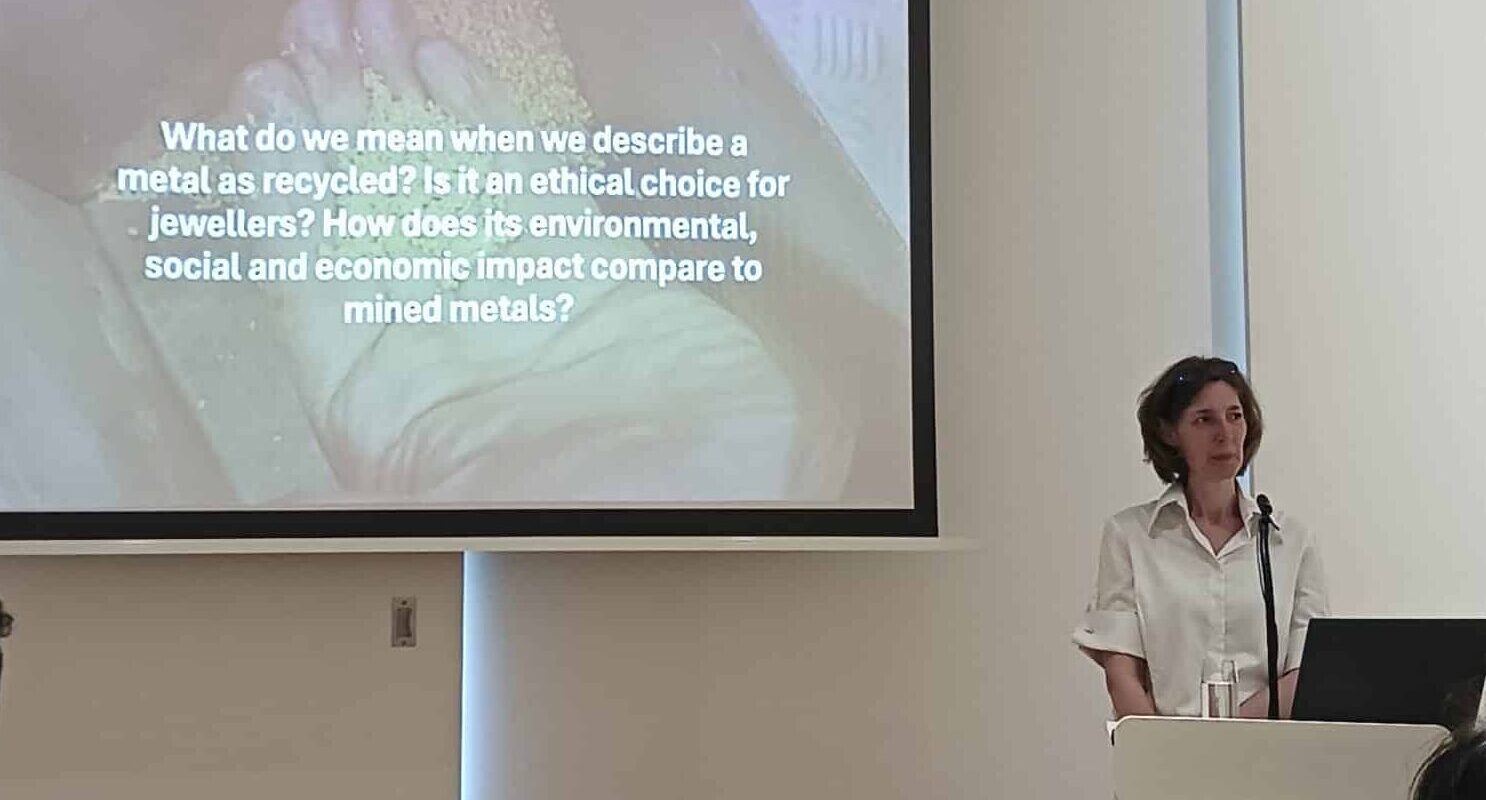
In July 2026, I was invited to give a talk at The Goldsmiths’Centre on a subject that has become increasingly important in my own work. The language we use when discussing gold, particularly the distinction between mined and recycled gold.
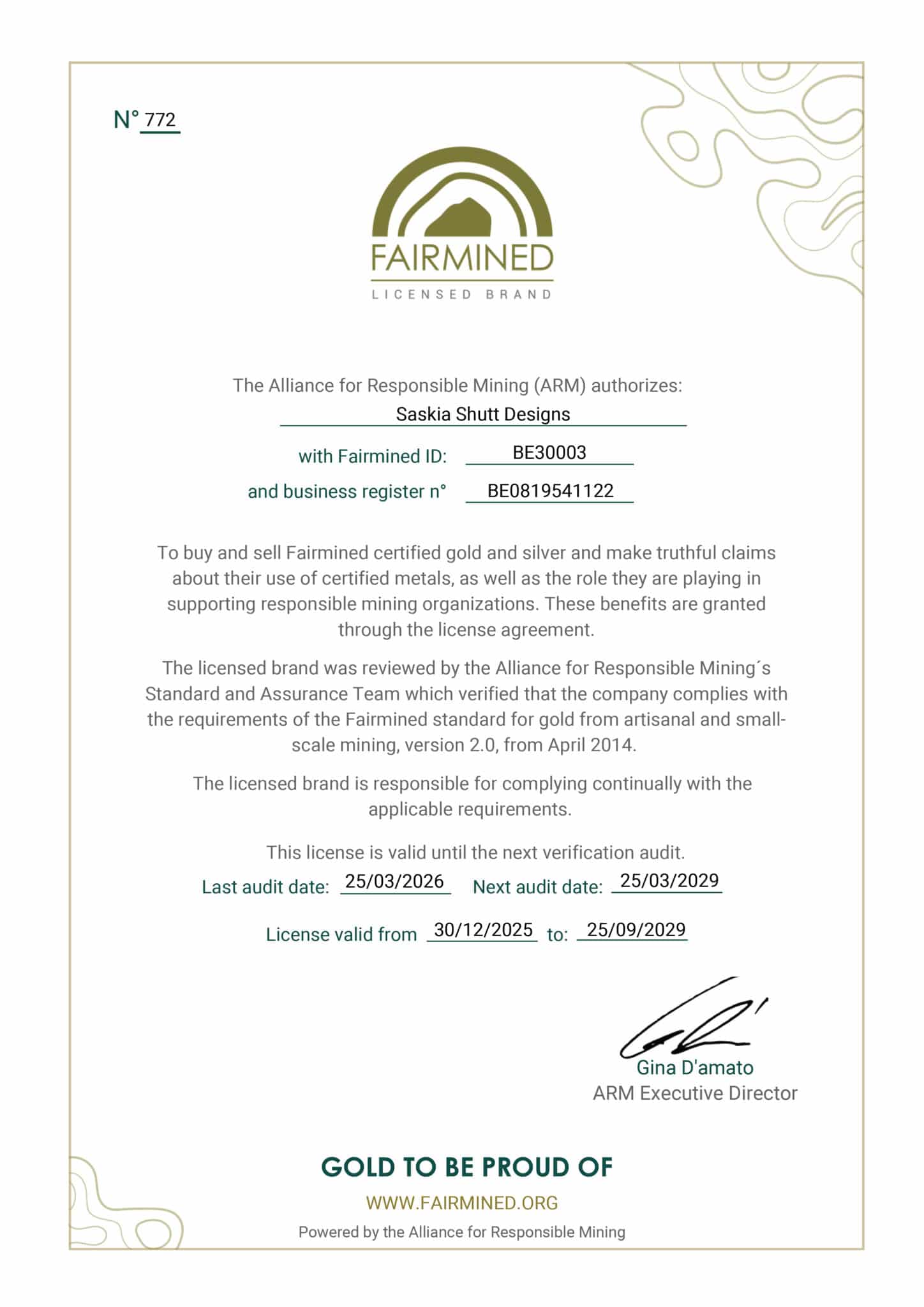
My starting point was the word “ethics” itself. Are we sometimes using this word too broadly when talking about gold? And do terms such as “recycled” or “mined” tell us enough about where a material comes from and what its production involves? To explore these questions, I looked back at my own journey — from moving my business back to Belgium, to becoming Fairtrade registered and, a few years later, becoming a Fairmined licensed brand.
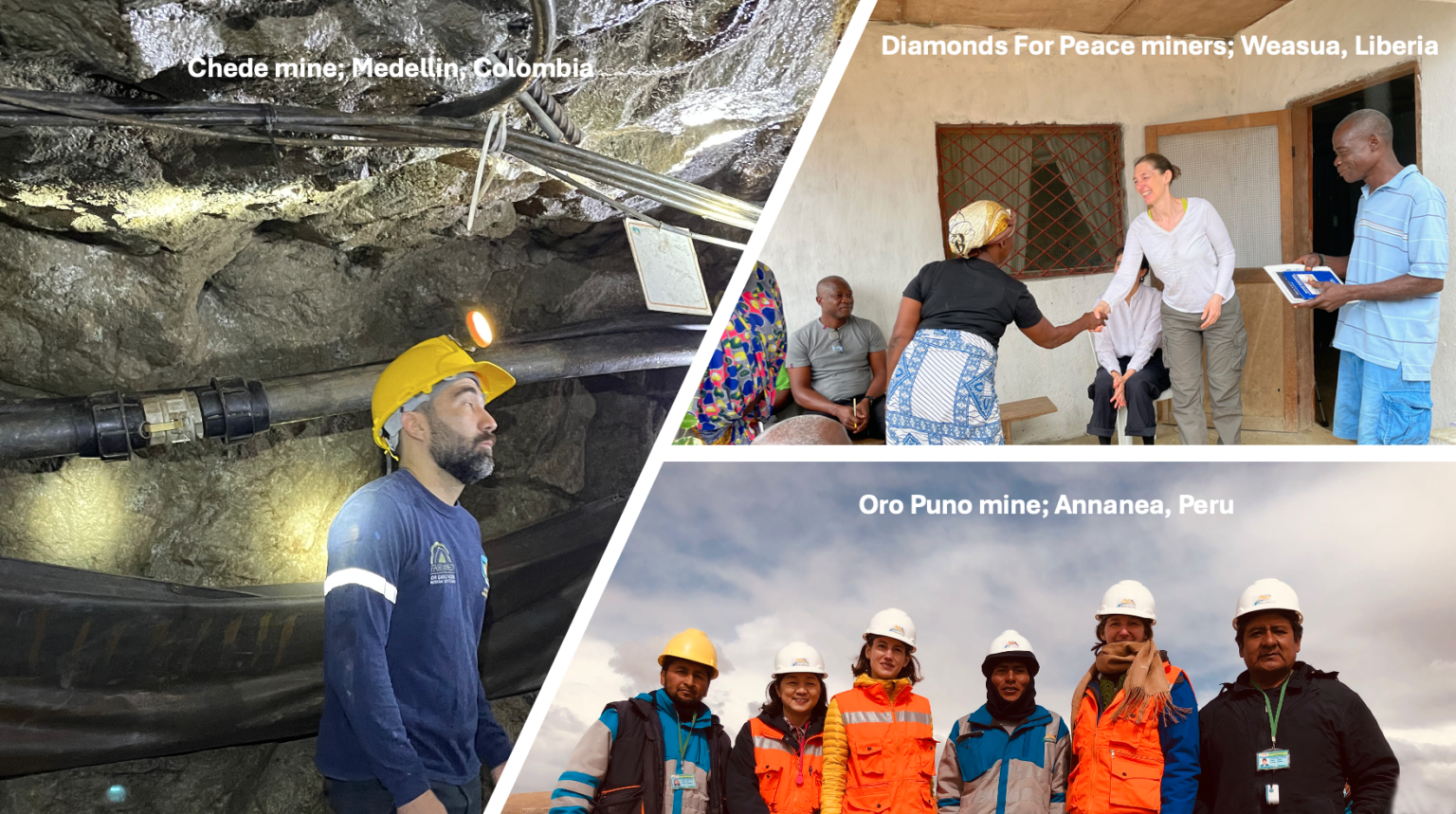
This journey has led me to take a particular interest in Artisanal and Small-Scale Mining (ASM). I support initiatives that work with ASM communities, including Diamonds for Peace and other organisations working to strengthen opportunities within small-scale mining.
That experience inevitably shapes the way I approach the question of mined versus recycled gold. But I don’t believe the discussion can be reduced to which one is simply “better”.
Mining and recycling are different systems, with different characteristics, challenges and potential benefits. To understand either properly, we need to look at them separately — at how the material is produced, where it comes from, who is involved, and what claims we can substantiate about it.
That is the purpose of this article: to question the language we use, examine the differences between mined and recycled gold, and look beyond the labels.
What choices do we have when buying gold?
When I first started thinking seriously about sustainability in jewellery, I believed what many of us believed: that recycled gold was the obvious choice. It seemed obvious. If existing gold could be used again, why would we need to mine more?
But the more I learned, the more questions I had. What does “recycled” actually mean? Where did that gold originally come from? What information about its previous history remains available? And what are the implications for the people and communities involved in artisanal and small-scale mining?
Those questions eventually took me beyond books and reports. They took me to Peru, where I visited the Oro Puno mine and met members of the mining community, and to Colombia and Liberia, where I met people involved in small-scale mining and learned more about their communities and livelihoods.
What do we actually mean by "recycled"?
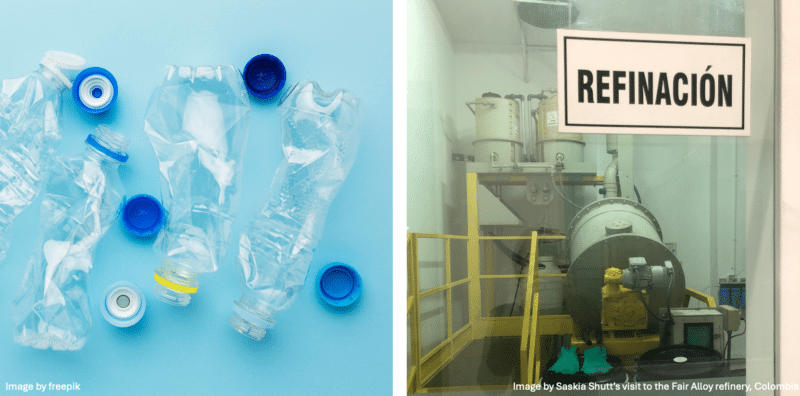
Recycled gold is a term we hear all the time. Consumers hear it. Jewellers use it. Retailers promote it. But what does it actually mean?
When we hear the word “recycled”, many of us instinctively think of household recycling: plastic bottles, glass, paper, aluminium cans. These are materials that have been used, collected, processed and turned into new material or products.
Gold is different.
Gold is a precious metal that can be recovered, refined and used again without losing its fundamental material properties. But the word “recycled” does not, by itself, tell us where that gold originally came from, how it entered the recycling stream, or what information about its previous history is available.
That distinction matters to me. If we want to understand the choices we make as jewellers, we need to look beyond the label and ask what the term actually tells us about the material.
What makes gold different?
We don’t usually throw gold away. Gold holds financial and material value, and it is often inherited, passed from one person to another, remodelled or refined. It can change hands and change form, but the material itself can remain in circulation.
That is why I believe comparing gold directly with materials such as plastic can be misleading. Plastic products are often designed for particular uses and can become waste when those uses come to an end. Gold is a precious metal that can be recovered, refined and fabricated again and again.
One of the remarkable characteristics of gold is precisely this ability to be reused without losing its fundamental material properties.
But “recycled gold” tells us how the material has been processed; it does not necessarily tell us where the gold originally came from. The recycled material may have entered the refining system through different routes, and the available information about its previous history can vary.
I do, however, value the opportunity to remodel existing jewellery and give the material a new form. But this is different from assuming that recycled gold is always the preferable choice when purchasing new precious metal. My question is a different one: does the fact that gold has been recycled, on its own, tell us enough to describe it as a better choice? And does choosing recycled gold necessarily reduce demand for newly mined gold?
These are more complicated questions than the label “recycled” might suggest.
I ask myself the same question when I buy platinum and palladium. I purchase these metals directly from refineries as recycled material, but I don’t describe them simply as “traceable recycled metal”. Why? Because I don’t have sufficient information about the original provenance of the material. The feedstock entering a refinery can come from different sources, including previously manufactured products and industrial or manufacturing waste, and the material may be blended during the refining process.
So, in my view, “recycled” describes a process, not a complete history of provenance.
And that is where things become interesting. Because there isn’t just one type of recycled precious metal.
Let’s break it down.
Breakdown into types of gold waste
Manufacturing scrap
Obsolete jewellery
Dental gold
Investment bullion
Unsold jewellery
Electronic waste
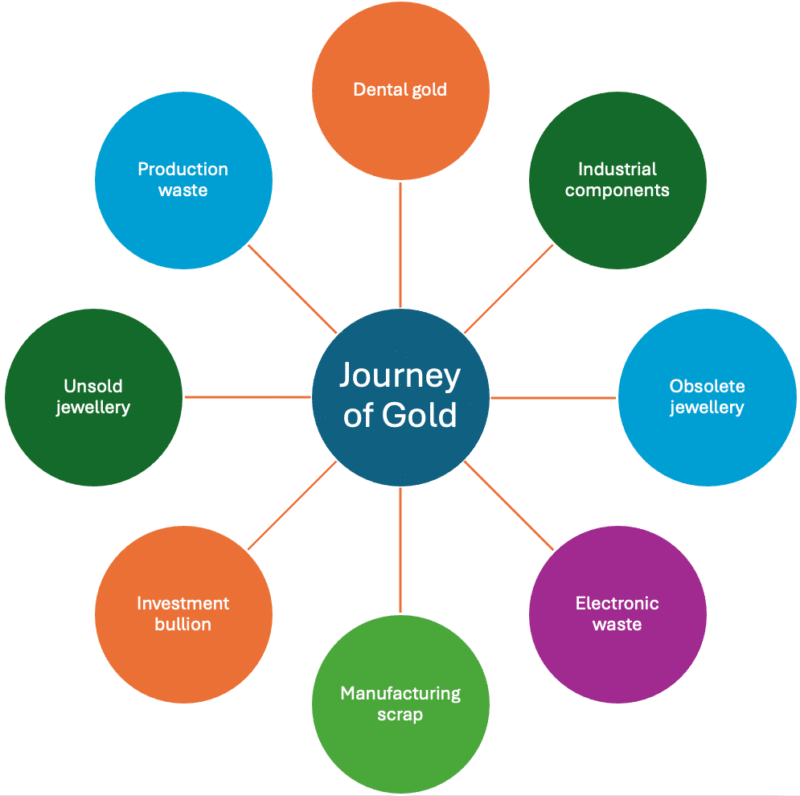
Should all of those really sit under one umbrella term?
This is where the terminology becomes particularly interesting.
The LBMA definition of recycled gold is remarkably broad. It traditionally includes gold-bearing material that has not come directly from a mine in its first gold life cycle. This can include post-consumer products, scrap and waste, material arising during refining and manufacturing, investment gold, and even fully refined gold products such as bars, coins and grain that have previously been sold and are subsequently returned to a refinery.
So, under this definition, a gold bar that has already been sold into the market can potentially become “recycled gold” when it is returned to a refinery for another lifecycle.
This is where I think we need to pause and ask what we actually mean when we use the word “recycled”.
For me, it is useful to distinguish between gold that has reached the end of a product’s useful life and gold that has simply been returned to a refinery after changing hands or being used in another part of the supply chain.
A piece of broken jewellery, an old gold tooth or gold recovered from electronic equipment has a very different history from a Good Delivery bar that has been sold, held as an investment and later returned to a refinery.
Both may fall within the LBMA’s definition of recycled gold. But do they tell us the same story?
This distinction matters because “recycled” describes what has happened to the material within the supply chain; it does not necessarily tell us where the gold originally came from.
And even LBMA acknowledges that its current definition is intended for responsible-sourcing due diligence rather than as a definition for consumer product claims. The organisation has been involved in work to distinguish secondary material for due-diligence purposes from recycled material used in product claims.
That is precisely why I think we need to look more closely at the different materials that can sit beneath the single label “recycled gold”.
recycling versus remodelling

I also think it is important to distinguish between recycling and remodelling.
In my work, when a client brings me old gold jewellery or gold teeth that belong to them, I describe what I do as remodelling. The material remains part of the client’s own story, and my role is to transform it into something new.
This is different from sending precious-metal material to a refinery for recovery and returning the refined metal to the wider supply chain. I don’t describe my clients’ jewellery as “recycled gold” when I remodel it.
For me, terminology matters. The words we use can tell us something about what has actually happened to a material and what hasn’t.
The same applies to mining. Large-Scale Mining (LSM) and Artisanal and Small-Scale Mining (ASM) are not interchangeable terms. They describe different scales and forms of mining, with different structures, operating contexts and challenges.
I’ll come back to this distinction later, because understanding the terminology is essential to understanding the wider discussion around gold.
Does "recycled" tell us anything about provenance?
Not necessarily. The word “recycled” tells us something about what has happened to the material within the supply chain. It does not, by itself, tell us where the gold originally came from.
You may be able to trace a piece of jewellery backwards through a documented chain of custody:
consumer → jeweller → wholesaler → refiner
But what happens when that chain reaches the refiner?
If the refiner can document the immediate source of the recycled material but cannot establish where the gold originally entered the supply chain, then the chain of custody ends there. We know who handled the material, but we don’t necessarily know its original provenance.
So “recycled” does not, on its own, tell us:
where the gold was originally mined
when it was mined
who mined it
under what conditions it was produced
how it entered the recycling stream
And let’s not forget that all recycled gold was, at some point, mined gold. Recycling describes a later stage in the material’s journey; it does not erase the fact that gold had an original source.
This is why I think it is important to distinguish between traceability of a material through a supply chain and provenance of the material itself.
For me, that distinction matters. It is also why I became increasingly interested in technologies such as blockchain, which can be used to record information about provenance and movements through a supply chain. I’ll explore this in more detail in another article.
Does recycled automatically mean environmentally better?
Not necessarily. We all know that mining has environmental impacts.
But refining also has impacts.
Both mining and recycling involve energy use, emissions and industrial processes. The question isn’t which has zero impact — because neither does.
The more useful question is: What impacts are we measuring?
Carbon emissions? Biodiversity? Water? Communities? Employment? Energy use? Traceability?
And even when we are talking specifically about carbon emissions, we need to be clear about where those emissions occur and how they are accounted for.
For a jeweller, emissions associated with the extraction and production of purchased gold are generally part of the company’s Scope 3 value-chain emissions. Electricity purchased and used in the atelier falls under Scope 2.
This distinction matters because simply saying that recycled gold has a lower environmental impact than mined gold doesn’t tell us which impacts have been measured, where they occur, or what data the comparison is based on.
So rather than asking whether recycled gold is automatically environmentally better, I think we need to ask a more precise question:
Better in what respect, measured how, and based on what evidence?
Refining Gold
Refining gold is an industrial process that uses energy and, depending on the process and material being refined, chemicals to separate gold from other metals and impurities and produce a higher-purity material. Different refining methods are used depending on the composition of the feedstock and the required purity. These can include chlorine refining, electrolysis and chemical processes such as aqua regia.
Modern refineries may use systems that recover and reuse chemicals and other materials within the process, but refining is not an impact-free process.
There is another aspect of refining that is particularly important to my discussion: provenance.
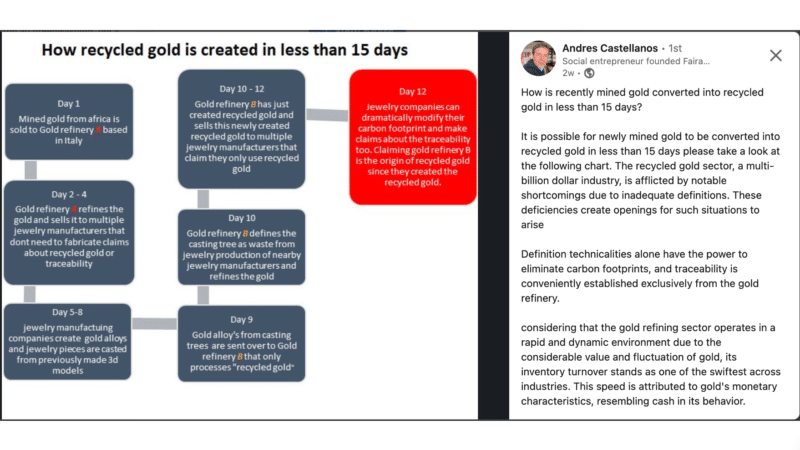
When different sources of gold are brought together for refining, the physical identity of the original pieces of metal is lost. The refined gold may subsequently be made into grain, bars or other forms, and the individual atoms can no longer be associated with the particular objects they came from.
Documentation can preserve information about a material’s origin and movement through a supply chain, but refining itself does not create provenance.
This is the distinction I want to make: refining can create a highly pure material, but purity is not the same thing as provenance, and traceability depends on the information and chain-of-custody systems surrounding the material.
The diagram below, provided by Andrés Castellanos of FairAlloy, illustrates this point visually: as different sources enter the refining process, their individual identities are combined into a new material stream.
[Slide image: How refining works and how the individual sources become indistinguishable during the refining process]
Diagram provided by Andrés Castellanos, FairAlloy, on LinkedIN)
Does Recycling Reduce the Need for Mining?
There is an assumption that if we recycle more gold, we will automatically need to mine less gold.
But is that actually what happens?
Recycled gold contributes to the available supply of gold. The World Gold Council estimates that recycled gold accounted for around 1,404 tonnes of supply in 2025, while mine production reached 3,672 tonnes. Yet both sources of supply increased that year.
The same pattern continued into the first quarter of 2026: recycled gold increased by 5% year-on-year, while mine production increased by 2%.
This doesn’t prove that recycling has no effect on mining. It does show that more recycling does not automatically translate into less newly mined gold.
There is another part of the picture that is often overlooked: demand.
Gold is not only used for jewellery. It is also bought by investors, central banks and industry. In 2025, global investment demand reached 2,175 tonnes, an 84% increase from 2024, while total gold demand exceeded 5,000 tonnes for the first time.
When demand for gold remains high, recycled gold becomes an additional source of supply — but it does not necessarily replace newly mined gold.
This matters to me because choosing recycled gold is sometimes presented as a way of reducing the need for newly mined gold. I don’t think the evidence allows us to make that assumption so simply.
Reusing Gold Is Nothing New
Sometimes recycled gold is presented as though it represents a new idea. But jewellers have been melting, repairing, remodelling and reusing precious metals for thousands of years. There is nothing new about reusing gold. In fact, one of the remarkable characteristics of gold is its ability to be recovered and used again without losing its fundamental material properties. Much of the gold mined throughout history remains in circulation in one form or another.
For me, the interesting question isn’t whether existing gold can be reused. I remodel my clients’ jewellery precisely because the material already belongs to them and can be given a new form.
This is different from choosing recycled gold as a source of newly purchased precious metal. When I need new gold for a piece, I choose Fairmined gold.
The question is therefore what we mean when we call material recycled, what its previous history tells us, and whether recycling alone tells us anything about the need for new mining.
A prime example is The British Crown Jewels

This shows that the regalia has been continually altered, rebuilt and remade over centuries. New monarchs commissioned new crowns; existing crowns were modified to fit different sovereigns. Gemstones were removed and reset.
Even the famous Imperial State Crown has been remade several times. After the execution of Charles I in 1649, Parliament ordered the medieval Crown Jewels to be broken up and melted down. Following the Restoration, King Charles II commissioned entirely new regalia in 1661. Since then, crowns have continued to be altered and remade for successive monarchs.
Differentiating between remodelling and recycling
Remodelled |
Identity retained: The original jewellery remains identifiable as part of the new piece. |
Provenance retained: The history of the material remains connected to the owner and the original piece. |
Story continues: The new jewellery carries a connection to what came before. |
Usually same owner/family: The material remains within the same personal or family context. |
Recycled |
Physical identity lost: Once material enters a refining process, the original object is no longer identifiable within the refined metal. |
Original provenance may no longer be physically identifiable: Information about the material’s earlier history may not travel with the metal through the refining process. |
Material enters a new lifecycle: The material enters a new commodity cycle, and the story that belonged to the original object no longer travels with it. |
Returns to the wider precious-metals supply chain: The material becomes available for use in new products and supply chains. |
When Does Remodelling Become Recycling?
There is another aspect to this distinction that I think is important.
What happens when a client owns a piece of gold jewellery but doesn’t want to have it transformed into something new? Perhaps they simply want to sell it. If I buy that jewellery from the client, melt the gold down and use the resulting metal to create a new piece of jewellery that I then sell to someone else, I would describe that as recycling.
The gold has entered the wider precious-metal supply chain. It is no longer connected to the original owner or the story of the original piece. But if that same client brings me their old gold jewellery and asks me to transform it into something new for them, I describe that as remodelling.
The physical process may involve melting and reforming the gold in both cases. The difference lies in what happens to the material and its relationship to the person who owns it. When remodelling, the material remains connected to the client’s story. With recycling, the material becomes part of a wider supply chain and is available to become something for someone else.
It is a fine line, but for me, it is an important one.
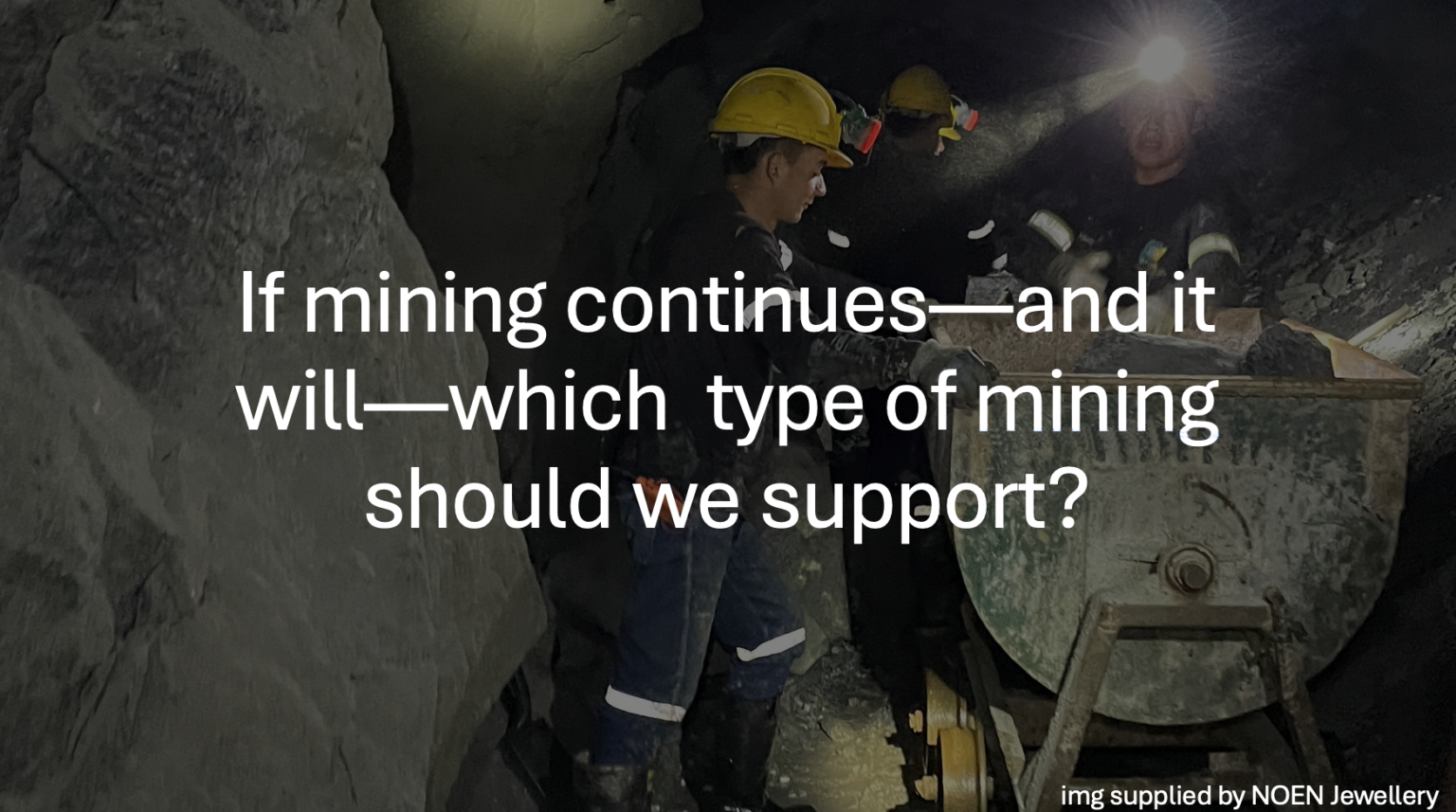
If Mining Continues, What Kind of Mining Should We Support?
If mining continues, then perhaps the more useful question is: what kind of mining are we talking about?
To understand what I mean, I want to break it down again, because there are many different forms and scales of mining. Once again, I don’t think we can talk about mining as though it were one single system.
There is Large-Scale Mining (LSM), Medium-Scale Mining (MSM) and Artisanal and Small-Scale Mining (ASM). There are also different sourcing models, such as Single Mine Origin (SMO), where the material can be identified as coming from a particular mine.
And then there is deep-sea mining, which is a very different proposition altogether.
At the time of writing, commercial exploitation of minerals from the international seabed has not yet begun under an approved exploitation contract. Much to my relief, the question of whether and how deep-sea mining should proceed is still being debated internationally.
For me, this is precisely why terminology matters. If we simply say mining, we can end up comparing very different activities as though they were one and the same.
So let’s look at them separately.
Large-scale mining
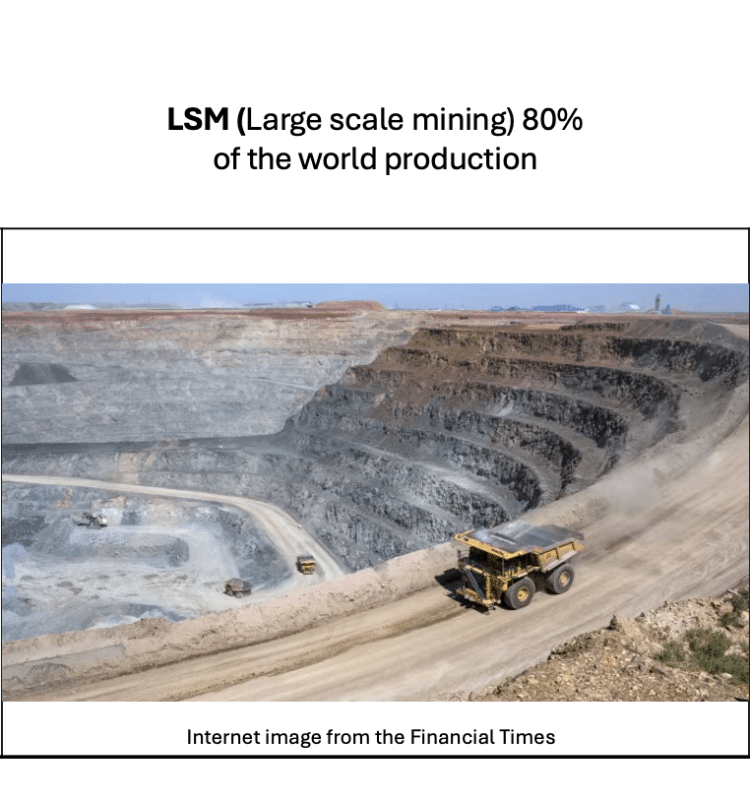
Large-Scale Mining (LSM) generally refers to industrial mining operations undertaken by large companies, often using substantial capital investment, mechanisation and specialised technology.
These operations can employ engineers, geologists, machinery operators and other specialised workers, alongside local employees and contractors. They can also contribute to national and local economies through employment, taxes, royalties, procurement and export revenues. The extent to which these benefits reach surrounding communities varies considerably from one operation to another and depends on factors such as employment opportunities, local procurement, taxation, community agreements and how revenues are distributed.
The scale of an LSM operation can also mean a significant physical footprint. Depending on the deposit and the method of extraction, mining may involve open-pit workings, underground operations, extensive infrastructure, waste-rock storage and processing facilities.
These activities can result in land disturbance, habitat loss, changes to landscapes, water use and water-quality risks, as well as greenhouse-gas emissions and other environmental impacts. Mining companies may have environmental management, rehabilitation and monitoring programmes in place, but the effectiveness of these measures varies between operations.
So when I talk about Large-Scale Mining, I don’t want to suggest that every operation has exactly the same social or environmental record. LSM describes a scale and model of mining; it doesn’t, on its own, tell us whether a particular mine is well or poorly managed, or what its actual impacts are.
That distinction is important when we compare different sources of gold.
Single mine origin and Artisanal and small-scale mining
Single Mine Origin (SMO) is a supply-chain initiative that aims to keep gold traceable to a single named mine. SMO Gold is kept segregated through its chain of custody, with the origin of each batch documented from the mine through refining and onwards to manufacturing. The process is independently audited, and the gold can be identified through a batch number and QR code.
SMO works with selected commercial mining operations and uses recognised mining frameworks as part of its mine-level due diligence. It is therefore quite different from Fairmined, which is specifically designed for Artisanal and Small-Scale Mining (ASM).
I have to admit that SMO is an area I know less about than Fairmined, so I don’t want to make claims about it that go beyond what I have been able to establish. What interests me about the model is the emphasis on maintaining the identity of the gold through a segregated supply chain and making the named mine visible to the buyer.
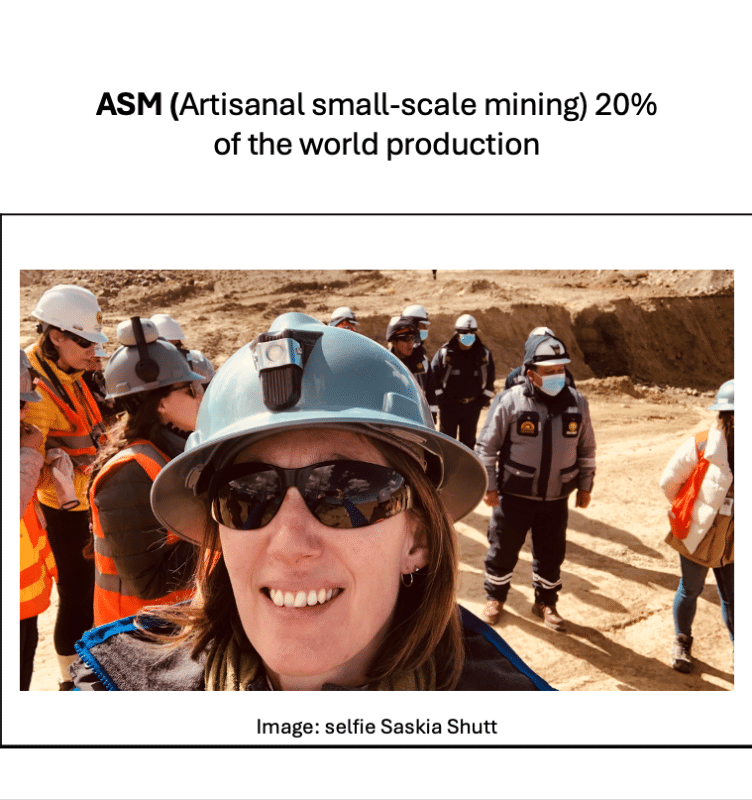
Artisanal and Small-Scale Mining (ASM) is where my heart lies.
ASM is very different from large-scale industrial mining. It can involve individuals, families, cooperatives and small mining organisations, often with a strong connection to the communities where they operate. The work can be highly labour-intensive, with miners using relatively simple tools alongside more mechanised or technical methods, depending on the operation.
For many communities, ASM is an important source of livelihoods and economic activity. At the same time, the sector faces significant challenges, including informality, occupational health and safety risks, environmental impacts and limited access to formal markets and finance.
This is where Fairmined comes in for me. Fairmined is a certification system specifically for artisanal and small-scale mining organisations. Mining organisations must meet the requirements of the Fairmined Standard and undergo an assurance process that includes auditing.
My interest in Fairmined comes from the opportunity to support ASM organisations that are working towards formalisation, improved practices and access to a formal international market — while also being able to identify where the gold comes from.
This is also why I don’t want to talk about mining as though it were one single thing. LSM, SMO and ASM represent very different approaches to how gold is mined, documented and brought into the supply chain.
Why Artisanal and small-scale mining
Despite producing around 20% of the world’s gold, Artisanal and Small-Scale Mining (ASM) supports an enormous number of livelihoods. The World Bank estimates that around 45 million people work directly in ASM worldwide, with hundreds of millions more involved in the wider labour and service networks connected to the sector.
This is one of the reasons ASM matters to me. It isn’t simply a question of where gold comes from. It is also about the people and communities whose livelihoods are connected to the extraction, processing, transport, trade and services surrounding mining.
But there is another side to this story.
ASM is not automatically benign, and artisanal, small-scale, informal and illegal mining are not interchangeable terms. ASM describes a scale and form of mining; informality refers to whether an operation is operating outside formal legal, regulatory or administrative frameworks, while illegal mining involves activities that violate applicable laws. A mining operation can therefore be artisanal and small-scale without being illegal.
Where ASM is informal or poorly regulated, the challenges can be considerable. These can include unsafe working conditions, limited access to finance and technology, environmental degradation and exposure to hazardous substances.
Mercury is one of the most serious concerns in artisanal and small-scale gold mining. UNEP estimates that ASGM is responsible for around 37% of global mercury pollution, making it the largest source of anthropogenic mercury pollution. Mercury can enter the environment during gold processing and can pose serious risks to the health of miners and surrounding communities.
Cyanide is also used in some gold-processing operations, and inappropriate handling can create environmental and health risks. These problems are precisely why formalisation, access to appropriate technology, training, finance and safer processing methods matter.
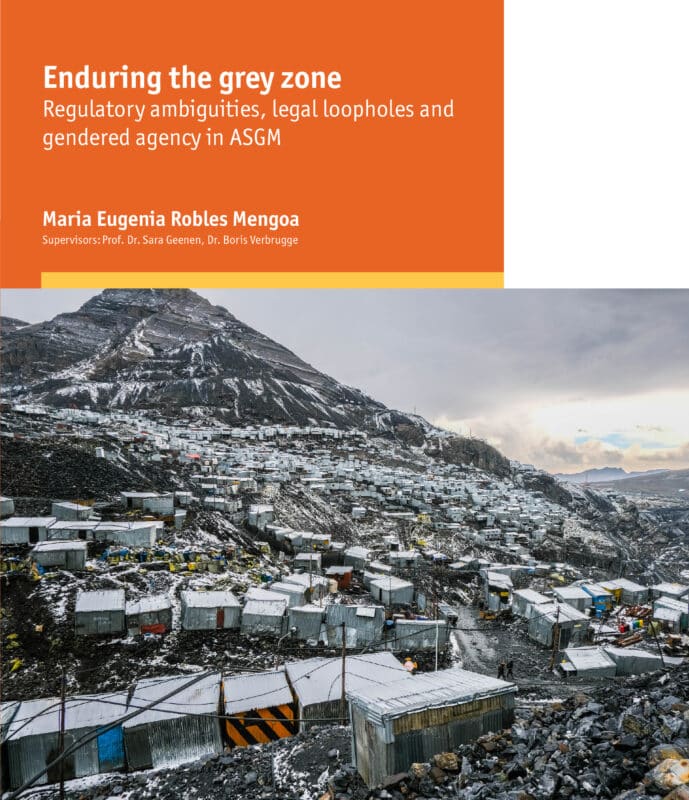
There are also places where the social conditions surrounding informal gold mining are particularly severe. La Rinconada in southern Peru is one example.
Located at around 5,100 metres above sea level, La Rinconada is widely described as the world’s highest permanent settlement. Its economy is heavily dependent on gold mining, and the town has grown rapidly alongside the rise in gold prices. Reports have documented severe problems with sanitation, waste management, mercury exposure and working conditions.
The International Labour Organization has also documented serious problems there, including exploitation of miners, crime and violence.
La Rinconada is an extreme example, and I don’t want it to become shorthand for ASM as a whole. This is precisely the distinction I want to make.
ASM is a diverse sector. Some operations are informal and face serious social and environmental challenges. Others are working towards formalisation, improved working conditions, safer processing and access to legitimate markets.
For me, the question isn’t whether ASM is perfect. It clearly isn’t.
The question is whether we support systems that help mining communities move towards better conditions, greater transparency and access to formal markets, rather than simply writing off the entire sector because some operations face serious problems.
This is one of the reasons I chose to work with Fairmined gold.
What does informal mining look like?
When I was in Peru on the Fairmined trip in 2022, fellow jewellers, including a German couple who are Fairmined Advocates, travelled with a journalist and tried to visit La Rinconada. Even with the funds they offered private security firms, no-one was willing to take them into the city because of the security risks.
I am fortunate to have a Peruvian friend, Dr Maria Eugenia Robles Mengoa, who researched informal mining for her PhD and has visited informal mining sites in several parts of the world, including La Rinconada. I was in the audience for her doctoral defence at the University of Antwerp on Friday 6 March 2026. She has kindly allowed me to reproduce the photograph shown here, which appears on the cover of her doctoral thesis, Enduring the Grey Zone: Regulatory Ambiguities, Legal Loopholes and Gendered Agency in ASGM. She has also generously allowed me to read her research.
Her research also connects with work published by Mike Pieth in his book Gold Laundering: The Secret World of the International Gold Trade. I have read the book myself, and Eugenia contributed several photographs to it. Seeing some of her fieldwork appear in the book gave me another perspective on the complexities of informal and illegal gold mining and the wider gold supply chain.
The closest I have ever come to La Rinconada was during my visit to CECOMIP, a Fairmined-certified gold mining organisation, at approximately 4,800 metres above sea level. From the CECOMIP site, La Rinconada can be seen in the distance, marked by a large dark area on the mountainside.
Sadly, informal mining exists in many parts of the world. This is one of the reasons initiatives such as Fairmined (South America), Fairtrade (South America), Peace Gold (Africa), and Mercury Free Mining (Africa) have developed different approaches to working with artisanal and small-scale mining communities.
These organisations and initiatives address different aspects of artisanal and small-scale mining, including formalisation, working conditions, environmental practices, access to markets and the reduction of mercury use.
For me, this raises an important question about how we engage with artisanal and small-scale mining communities. Rather than treating ASM simply as a category to avoid, I believe it is important to understand the different circumstances in which it operates and the initiatives working with mining communities to address the challenges they face.
Sadly, informal mining exists in many parts of the world. This is one of the reasons initiatives such as Fairmined (South America), Fairtrade (South America), Peace Gold (Africa), and Mercury Free Mining (Africa) exist.
These organisations and initiatives take different approaches, but they share an interest in addressing some of the challenges faced by artisanal and small-scale mining communities. From formalisation and working conditions to environmental practices, access to markets and reducing the use of mercury.
For me, this is important. I don’t believe the answer to the challenges of ASM is simply to turn away from these mining communities. I believe it is also important to support initiatives that work with miners and communities to address those challenges and create opportunities for change.
Deep sea mining
Another form of mining that is being pursued by commercial interests is deep-sea mining.
One of the reasons I personally oppose deep-sea mining is that we still know relatively little about many of the ecosystems that would be affected. The deep ocean contains highly specialised habitats and species, some of which have adapted to environments that are very different from those found closer to the surface.
The concern is not simply that mining would disturb these ecosystems, but that we don’t yet know enough to understand the full consequences of that disturbance — or how long affected ecosystems might take to recover.
Research into deep-sea mining has identified several potential impacts, including the disturbance of the seabed, sediment plumes, underwater noise and the release or redistribution of particles and potentially toxic substances. Sediment plumes could extend beyond the immediate mining area and affect organisms that rely on the surrounding water column or seabed. Scientists are particularly concerned about organisms that are poorly understood and ecosystems that may recover extremely slowly.
Some deep-sea habitats are also home to organisms that grow and reproduce very slowly. This means that recovery from significant physical disturbance may take decades or longer, and in some cases the extent to which an ecosystem can recover remains uncertain.
That uncertainty is one of the reasons I personally oppose deep-sea mining. I don’t believe we know enough about these ecosystems, their functions or their capacity to recover to justify introducing large-scale industrial extraction into them.
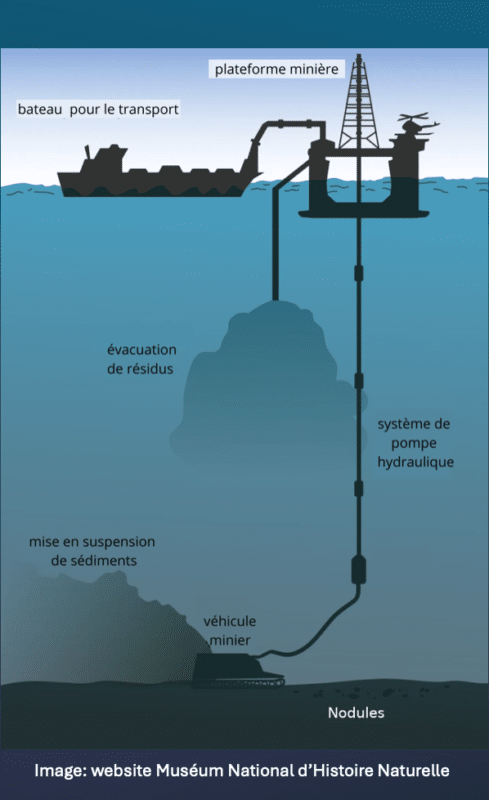
Do We Really Need to Mine the Deep Sea?
And there is another question I keep coming back to: do we actually need to? Gold is already in circulation. Much of the gold mined throughout history still exists in some form, and gold can be recovered, refined and used again.
For me, that raises a fundamental question. If we already have gold above ground, why would we need to open up an entirely new and poorly understood environment to extract more? That is why, personally, I would rather see the gold already in circulation used, recovered and traced, and existing mining systems improved, before we consider opening the deep ocean to commercial mineral extraction.
A brief comparison
Which brings me to the subject of emissions. But you can’t compare apples and pears.
When comparing the carbon emissions associated with different sources of gold, we need to look at the specific mining operation and the conditions in which it operates. The scale of the mine is one factor, but it is certainly not the only one.
For example, an artisanal and small-scale mine using a 20-year-old diesel generator in the middle of the Peruvian desert will have a very different emissions profile from a mine of a similar scale that has access to an electricity grid supplied largely by hydropower in Colombia.
The same applies within ASM. A Fairmined-certified mining organisation operates under the Fairmined Standard, which includes requirements relating to environmental practices and energy use. But that doesn’t mean that every Fairmined mine has the same carbon footprint, or that we can assign one emissions figure to all ASM.
And we also have to remember that informal mining is extremely difficult to quantify. We don’t have reliable global data for the number of informal mining operations, let alone comparable emissions data for all of them.
The same principle applies to Large-Scale Mining.
A deep underground mine in South Africa, operating at around 4,000 metres and using electricity generated from a coal-intensive grid, will have a very different emissions profile from a large-scale mine in Nevada supplied by a grid with a different electricity mix.
So when we compare the emissions of mined gold, “ASM versus LSM” isn’t enough information.
We need to ask:
- Which mine?
- Which mining method?
- How deep?
- What is the ore grade?
- What energy is being used?
- How is the ore processed?
- And what boundary are we using to measure the emissions?
Only then can we make a meaningful comparison.
The importance of supporting responsible ASM
As I mentioned earlier, Artisanal and Small-Scale Mining (ASM) supports around 45 million people working directly in mining worldwide, with many more people depending on the sector indirectly through families, local businesses and wider community economies.
So I find myself asking: what happens to these communities if we only promote recycled gold as the solution?
Many ASM communities are located in remote areas where mining is an important part of the local economy. Simply turning away from newly mined gold does not make these communities disappear, nor does it address the challenges they face.
Initiatives such as Fairmined and programmes working to reduce mercury use do not exist to encourage people to mine more gold. They exist because mining is already taking place, and because there is an opportunity to work with mining communities to improve practices, strengthen working conditions, reduce harmful impacts and create access to more formal markets.
For me, supporting these initiatives is not about promoting mining for its own sake. It is about recognising the people who are already part of the gold supply chain — and asking what role we can play in supporting positive change within the systems that already exist.
Environmental Protection
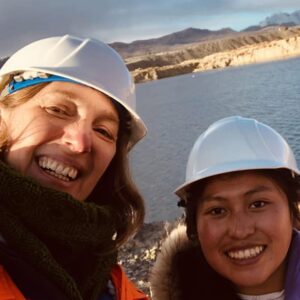
Environmental protection is another important part of the work being done with mining communities. This can include protecting biodiversity, restoring areas affected by mining and reducing pressures on local ecosystems.
Biodiversity and reforestation
Both Fairmined and Diamonds for Peace support projects that include tree planting and reforestation. I have contributed to this work myself by donating orange trees to Diamonds for Peace.
Energy
Reducing reliance on fossil fuels and using renewable energy, such as solar power, can also be part of improving the environmental practices of mining operations. The possibilities depend on the location and infrastructure available to each mining community.
Water stewardship
Protecting water resources is particularly important in mining, where poorly managed operations can create risks to water quality.
This is something I have seen first-hand during my visits to Fairmined mining organisations in Peru, including Oro Puno, CECOMIP and Cruz Pata. At Cruz Pata, the water reservoir is home to trout — a fish that is also an important part of the local Peruvian diet.
I remember being struck by the number of trout in the reservoir. Seeing them there gave me a very tangible connection to the importance of protecting the water surrounding the mining community. I wouldn’t use the presence of fish as scientific proof of water quality, but it was a memorable reminder that mining and the surrounding ecosystem are not separate things. What happens at a mine can matter to the water, wildlife and communities around it.
For me, this is one of the reasons it is important to look beyond the simple label of “mined” gold. The question is not only whether gold has been mined, but how it was mined, what practices were in place, and what information we have about those practices.
Social and Economic Growth
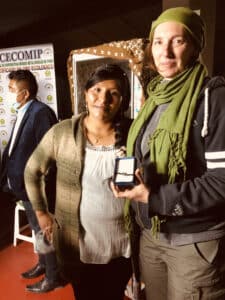
Responsible mining is not only about what happens to the land and the materials that are extracted. It is also about the people who depend on mining for their livelihoods and the communities in which they live.
Working conditions and opportunities
Fairmined certification includes requirements relating to working conditions, health and safety, and the rights of workers and mining organisations. Beyond mining itself, some initiatives also support opportunities for people within mining communities to develop additional skills and sources of income.
At CECOMIP in Peru, I saw an example of this first-hand. The organisation supported a group of women miners in establishing a jewellery workshop and helped them develop opportunities to sell their jewellery in nearby towns. The women call themselves “Las Divinas”
Investing in communities
The Fairmined Premium provides certified mining organisations with an additional payment that is invested collectively according to their own priorities and the Fairmined requirements. This can support community projects and improvements in areas such as education, healthcare and infrastructure.
This is particularly significant for remote mining communities, where access to services and infrastructure can be more limited.
Fair trade and community relationships
For me, fair trade is also about recognising that miners are not simply suppliers of a raw material. They are people participating in a supply chain, with their own communities, priorities and aspirations.
I saw another example of this at Oro Puno in Peru. The Fairmined mining organisation had identified an informal mining area within its territory. Rather than continuing to excavate simply because there might still be gold present, they cleared the area of waste and abandoned equipment, rehabilitated the site and planned to return it to a green area.
That stayed with me.
The presence of gold does not automatically mean that it should be extracted. In this case, the miners made a conscious decision about what to do with an area affected by informal mining, even though gold may still have remained underground.
For me, this is an important part of the conversation around mining: the value of gold cannot be separated entirely from the people, communities and decisions surrounding its extraction.
The Fairmined Premium
The Fairmined Premium is an additional payment received by certified mining organisations when they sell Fairmined gold. It is separate from the price paid for the gold itself and is intended to support the continued development of the mining organisation and its community.
The mining organisation decides how the Premium is invested through a participatory process, with investments directed towards areas such as workers’ welfare, strengthening the organisation, community development and environmental protection.
This can mean very different things from one mining community to another, because the priorities are determined locally. It may support improvements to mining practices, education, healthcare, infrastructure, environmental projects or other community needs.
For me, this is one of the important differences between simply buying a raw material and participating in a supply chain that creates an additional financial mechanism for investment in the mining organisation and its community.
The Premium doesn’t mean that every Fairmined mining community will use the money in the same way. What matters to me is that the mechanism exists, that its use is governed within the Fairmined system, and that the benefits can extend beyond the individual transaction of buying gold.
A Call for Informed Choices
Giving consumers meaningful information is important if we want them to be able to make informed choices about the jewellery they buy. The customer deserves to know where their gold comes from, what can be traced about its journey, and what information is available about its original source. They deserve to understand whether the material is newly mined, recycled or remodelled from an existing piece. Where information is available, to understand the people, communities and systems behind it.
For me, informed choice means looking beyond a single label and asking better questions. Not simply “Is this gold recycled?” or “Is this gold mined?”, but “What do we actually know about this gold?”
Slow Mining
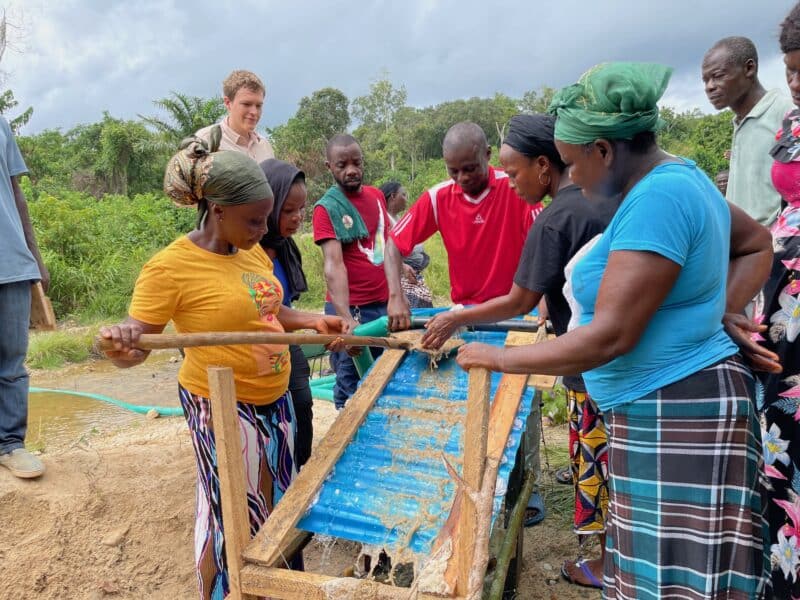
When we talk about sustainability in fashion, we often talk about slow fashion. Buying less, valuing craftsmanship, extending the life of what we already have and questioning the systems behind production.
I believe we should start asking similar questions about the way we extract precious metals. Perhaps we need to talk about slow mining.
By this, I mean questioning the assumption that we should continually increase the extraction of finite resources simply because the resources are there and there is a market for them.
I would like to see greater consideration given to the scale and pace of extraction, alongside stronger scrutiny of the environmental and social impacts of individual mining operations. This is particularly important for large-scale mining, where the physical footprint of an operation can be substantial and extraction can involve significant infrastructure, energy use, waste and land disturbance.
I recognise that placing limits on large-scale mining production is a much bigger and more complicated proposition than simply suggesting that it should happen. Mining provides employment, generates tax and royalty revenues and supplies materials that are used throughout the global economy. The benefits and impacts vary considerably between operations and locations.
But I believe it is still a question worth asking: do we need to extract every deposit that can technically and economically be mined?
Gold is different from many other raw materials because it does not disappear when we use it. Much of the gold ever mined still exists in some form, and gold can be recovered, refined, remodelled and used again.
For me, slow mining would mean taking that fact seriously.
It would mean looking not only at how efficiently we can extract more gold, but also at how we can make better use of the gold already in circulation, support mining operations where extraction continues, understand the impacts of individual mines, and ask whether every new source of extraction is necessary.
Perhaps the jewellery industry needs to move beyond the simple question of “mined or recycled?” and start asking a bigger one:
How much new gold do we really need — and how should we decide where it comes from?
For me, this is where the importance of supporting Artisanal and Small-Scale Mining (ASM) comes in. I believe that working with small mining communities, rather than simply turning away from newly mined gold, offers an opportunity to support longer-term change within communities that already depend on mining.
My hope is that by working alongside mining communities, supporting better working practices, environmental protection, skills, livelihoods and opportunities for future generations, we can help create mining communities where people can build a future while caring for the places in which they live and work.
This is something I have heard directly from the Fairmined certified miners and the Diamonds for Peace mining communities I have met. They have spoken to me about their pride in being part of efforts to improve their communities and the way mining is carried out.
That sense of pride and ownership is something I find very powerful. It reminds me that this conversation is not simply about the gold we buy. It is also about the people who mine it, the communities they build and the future they want for the generations who come after them.
Responsible Artisanal and Small-scale Gold Mining
For me, Fairmined gold and similar initiatives are an important expression of the idea of slow mining. They are not about encouraging more extraction simply for the sake of producing more gold. They are about working with mining communities that already exist, and supporting specific changes in the way mining is carried out.
One of the most important examples is the reduction and elimination of mercury use in artisanal and small-scale gold mining.
Mercury is a neurotoxic substance that can cause serious harm to people and ecosystems. In artisanal and small-scale gold mining, mercury can be mixed with gold-bearing material to form an amalgam. When that amalgam is heated, mercury is released and can enter the air, soil and water. Mercury can also accumulate in food chains, including in fish.
This is why reducing mercury use matters not only to miners and their families, but also to the wider environment and communities that depend on local ecosystems and food sources.
Governments have also recognised the problem. In Colombia, the use of mercury in mining was prohibited from July 2018 under legislation introduced to eliminate its use in the mining sector. However, a legal prohibition does not necessarily mean that mercury use disappears immediately. Informal and illegal mining can be difficult to regulate, particularly in remote areas.
This is one of the challenges that I believe is important not to overlook when we talk about ASM. Artisanal and small-scale mining is not synonymous with informal or illegal mining. There are certified, formal mining organisations working within recognised standards, alongside mining operations that may operate outside formal systems. The challenges faced by each can be very different.
I have seen some of this complexity first-hand in Colombia. At the Chede mine, a Fairmined-certified mining organisation outside Medellín, the miners purchased a large area of Amazonian forest with the intention of preserving it. Yet informal miners subsequently entered part of that land and cleared forest to extract gold. The Chede miners could not simply prevent this from happening.
I was told that some informal mining in the region operates within a wider context involving armed groups, including guerrilla organisations. This is not my area of expertise, so I don’t want to make claims beyond what I have personally learned and what can be properly documented.
For me, this example illustrates why simply saying “stop mining” is not an adequate answer. There are already communities and mining organisations operating within these landscapes, alongside complex social, economic and legal realities.
The challenge is how we support mining communities that are trying to work within better systems, while also addressing the environmental and social problems associated with informal and illegal mining.
That, to me, is where initiatives such as Fairmined and mercury-reduction programmes have an important role to play.
Look Beyond the Label
Giving consumers meaningful information is essential if we want them to make genuinely informed choices.
A customer deserves to know where their gold comes from, what can be traced about its journey, and what information is available about its original source.
Is it newly mined gold? Recycled material? Gold that has been remodelled from an existing piece? And, where the information exists, can we understand something about the people and communities behind it?
For me, this is what informed choice should mean: not simply choosing between a label that says “mined” or “recycled”, but having enough information to understand what that label actually represents.
The more we know about the material we buy, the better questions we can ask — and the more meaningful our choices can become.
How Much Gold Do We Really Need?

When we talk about slow fashion, we question a system based on producing more, selling more and consuming more. I believe we should ask similar questions about precious metals.
Do we really need to continually increase the amount of newly mined gold entering the market?
This is where my idea of slow mining comes in. I would like us to think more carefully about the pace and scale at which we extract finite resources, particularly through large-scale mining operations.
Large-scale mining can involve enormous infrastructure, substantial energy use, significant land disturbance and the movement of vast quantities of rock and waste. The benefits of mining can include employment, investment, taxes, royalties and local procurement, but how these benefits are distributed — and how the environmental and social costs are managed — varies considerably from one operation to another.
That is why I find myself questioning the assumption that every economically viable deposit needs to be extracted, and whether the scale and pace of extraction always need to increase. But questioning the scale of extraction does not mean that I believe we should stop mining.
Quite the opposite.
As a Fairmined jeweller, I believe in the value of mining because I have seen the human value behind it. I have met miners whose livelihoods depend on mining, spoken with their families and visited communities where gold provides an important source of income and economic activity.
For me, the question is therefore not simply “How can we mine less?” It is “How can we support mining that creates meaningful livelihoods while paying greater attention to the people, communities and environments involved?”
And alongside that, I believe we should make thoughtful use of the gold that is already in circulation — through remodelling, reuse and recovery — rather than treating newly mined gold and existing gold as if they were the only two sides of a simple choice.
That, for me, is the idea behind slow mining: not turning away from mining, but questioning the pace and scale of extraction, supporting mining communities, understanding the consequences of individual operations, and making thoughtful choices about the gold we use.
I believe that focusing on ASM for longevity in a sustainable world is the key to a better and more harmonious future. Working with small mining communities to create a better environment for living and work for future generations is what I believe we need to aspire to. And from talking to the Fairmined certified gold miners and the Diamonds for Peace miners, all say how proud they are to be part of the change.
For me, Fairmined gold and similar initiatives are the embodiment of slow mining. It’s respectful, thoughtful, and deliberate. Empowering communities. Creating change.
Mercury in informal gold mining
One of the most serious challenges associated with informal gold mining is the continued use of mercury.
Reducing and ultimately eliminating mercury use is important to me — not only because of the risks to miners and their communities, but also because mercury can enter the wider environment and food chain. In artisanal and small-scale gold mining, mercury is used to form an amalgam with gold. When the amalgam is heated, mercury can be released as vapour, while mercury can also enter soil and water and accumulate in organisms such as fish. UNEP identifies artisanal and small-scale gold mining as the largest source of anthropogenic mercury emissions globally.
Colombia prohibited the use of mercury in mining from July 2018. Peru is also a party to the Minamata Convention, which requires measures to reduce and, where appropriate, eliminate mercury use in artisanal and small-scale gold mining. Yet legislation alone does not mean that mercury use disappears, particularly where mining takes place informally and outside effective regulatory systems.
This is why mercury reduction programmes matter to me. The challenge is not simply to tell miners to stop using mercury, but to support practical alternatives and help create the knowledge, technology and conditions that make those alternatives possible.
For me, this is another example of why I believe in working with mining communities rather than simply turning away from mining. If we want change to happen on the ground, we need to engage with the people who are actually doing the mining.

My Conclusion
Recycled gold certainly has an important place within our industry. Recovering precious metal that is already in circulation makes sense, and I believe recycling has a role to play in the future of jewellery.
But I also believe we need to be precise about what we mean by “recycled”. Recycling and remodelling are not the same thing. When a client brings me their old gold jewellery, teeth or coins, I remodel that material into something new. The gold remains connected to the person who brought it to me and, often, to the story attached to it.
At the same time, I choose to work with Fairmined gold and silver. I believe there is value in mining because there is human value behind it: miners, their families and communities whose livelihoods depend on mining. For me, supporting Fairmined mining organisations is a way of recognising that value while supporting a system with defined requirements around areas such as working conditions, environmental practices and traceability.
These choices are not contradictory.
We can make use of the precious metals already in circulation and recognise the continued role of newly mined gold and silver. We can remodel a client’s heirloom gold, recover precious metals through recycling, and choose newly mined Fairmined metals for new commissions.
Gold will continue to be mined. For me, the question is therefore not whether mining should exist, but what kind of mining we choose to support, and what we can know about the gold we buy.
As jewellers, our purchasing decisions connect us to the supply chains behind our materials. We can ask where our materials come from, how they have entered the supply chain, what can be traced about them, and who is involved along the way.
That is ultimately what this article has made me question: not whether one category of gold is automatically better than another, but whether we are asking enough questions about the materials we choose.
For me, the story of a piece of jewellery begins long before it reaches my workbench. I want to understand that story and, wherever possible, the people behind it. As a jeweller, I have the privilege of connecting those stories. From the people who mine and produce the materials to the person for whom I create the finished piece. I choose my materials consciously because I believe that understanding where they come from, and the people behind them, gives the jewellery a deeper story to tell.