Lost wax casting is one of the oldest jewellery-making techniques known to humanity. It dates back around 6,400 years, and remarkably, the fundamentals of the process have hardly changed. Ancient goldsmiths worked with beeswax and clay, while today we benefit from modern tools and rubber moulds. Yet, the soul of the technique remains the same: wax is transformed into precious metal through fire, skill, and precision.
Although I rarely use lost wax casting in my everyday work, the technique plays a vital role in certain areas of my jewellery practice. My approach as a goldsmith is usually to build my pieces up from scratch, carefully shaping and fabricating metal by hand. However, when I work on larger statement pieces or on certain remodelling projects, lost wax casting becomes the perfect solution.
In this article, I want to share the fascinating history of lost wax casting, how I learned it during my own training, how it is used in modern jewellery workshops, and why I still use it today for certain bespoke projects.
What Is Lost Wax Casting?
The process of lost wax casting, also known as cire perdue, has been around for millennia. From Mesopotamia to Egypt, from the Indus Valley to Africa, artisans discovered that wax could be used as a temporary model for objects in metal. The technique is simple in principle: create a model in wax, encase it in a mould, melt the wax away, and replace it with molten metal.
Even though tools and materials have evolved over time, the method has remained strikingly consistent. Today we may use investment powder instead of clay, and rubber moulds instead of carved stone, but the idea is exactly the same as it was thousands of years ago.
This continuity across time is what makes lost wax casting so special. When I work with this technique, I feel connected to generations of craftspeople who came before me. It’s a reminder that jewellery-making is both ancient and ever-evolving.


The Timeless History of Lost Wax Casting

Lost wax casting has been uncovered in ancient artefacts from civilisations across the world. Egyptian gold amulets, Mesopotamian figurines, and early Indian ornaments all reveal the marks of this process. The technique spread widely because of its versatility: it allowed artisans to create complex shapes and intricate details that were impossible with direct hammering or fabrication.
The technique’s endurance over 6,000 years proves its brilliance. It is a process that adapts effortlessly to time while keeping its essential nature unchanged.
My First Experience with Lost Wax Casting
My first introduction to lost wax casting came during my degree at Duncan of Jordanstone School of Art and Design between 1994 and 1997. The course gave me a taste of the technique, more of a teaser than a deep dive. At that stage, it was just one of many methods to explore as a student jeweller.
Two decades later, in 2020, I felt a strong pull to return to wax work. I enrolled in a wax techniques course at Syntra Brussel, under the expert tuition of Alain Roggeman and Nico Delaide.
With Alain, my fellow students and I discovered the different types of wax and their specific uses. Some waxes are soft and pliable, perfect for modelling, while others are hard and crisp, ideal for detailed carving. Each wax demands a different approach and has its own quirks. For me, the joy lies in carving in wax—shaping a form with deliberate precision, knowing that it will one day become metal. That is the part of lost wax casting I cherish most, and it is the technique I still use regularly in my workshop today.
With Nico, we turned to the subject of mould-making. His focus was on reproduction—using rubber moulds to create multiple identical pieces. This area of lost wax casting sits in contrast with my own work, but it gave me valuable insight into the world of small-scale jewellery production.
Wax Types and the Art of Wax Carving

Wax carving is both meditative and exacting. A block of wax becomes a canvas. I remove slivers, file surfaces, and build tiny details. Unlike working directly with metal, wax is forgiving. If I carve too deeply, I can melt a little wax and repair the surface. If I want to test proportions, I can adjust them before committing to metal.
This stage of jewellery-making feels intimate. I hold the piece in my hands in a way I cannot once it is metal. I can see the future form emerging, and yet it still feels alive and flexible.
Once carved, the wax is transformed into metal through casting. The fragility of wax is replaced by the permanence of gold or silver. The transition is always magical. What was once soft and ephemeral becomes solid and enduring.
Lost Wax Casting and Rubber Moulds in Jewellery Production
Rubber moulds are an essential part of lost wax casting when jewellers want to reproduce designs. A rubber mould captures every detail of an original piece. It can then be used to create wax copies, which are in turn cast into metal.
These moulds can last 10 to 20 years, depending on how often they are used. They are particularly useful for jewellers who need to produce collections in volume. Instead of carving each wax model from scratch, they can produce hundreds or even thousands of identical waxes from a single mould.
This method is efficient. It reduces manual labour, shortens production time, and lowers costs. It allows jewellery businesses to offer consistent designs at accessible prices.
In some cases, jewellers will cast the main body of a piece using moulds and then hand-finish each one. This hybrid method balances efficiency with artistry: the core design is replicated, but the finishing touches are still shaped by hand. It creates jewellery that is uniform in structure but still retains a unique character.


Why I Rarely Use Moulds in My Bespoke Jewellery Practice
In my own workshop, I very rarely use rubber moulds. My work is rooted in the philosophy of bespoke craftsmanship. Each piece I create is designed and made for one individual. It reflects their story, their gemstones, and their vision.
Carving each wax model by hand allows me to tailor the design precisely. When I carve a wax for a bespoke piece, I am not just shaping a model; I am shaping the foundation of a future heirloom. Every curve, every angle, and every recess is designed with intention.
This is particularly important when gemstones are involved. Gemstones are not uniform. They vary in shape, size, and cut. A hand-carved wax can be tailored perfectly to cradle the chosen stones. This level of precision simply cannot be achieved with standardised moulds.
Bespoke jewellery thrives on individuality. No two pieces should be the same. That is why I carve each wax fresh, with my client and their story in mind. No mould is made after casting in the desired precious metal.
Sand Casting vs. Lost Wax Casting
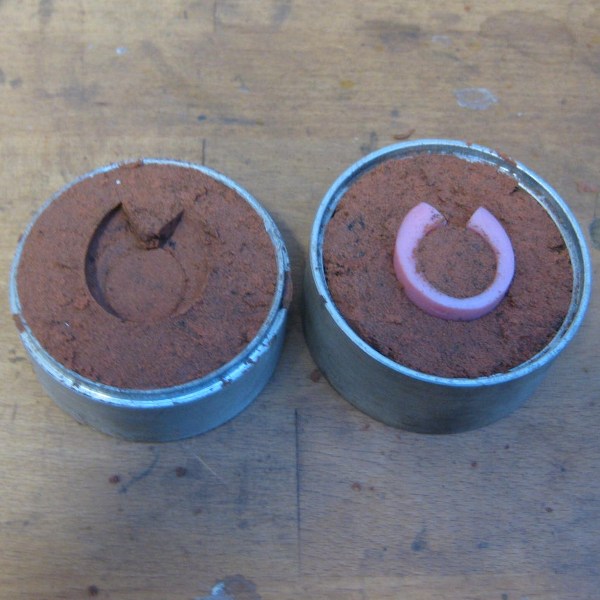

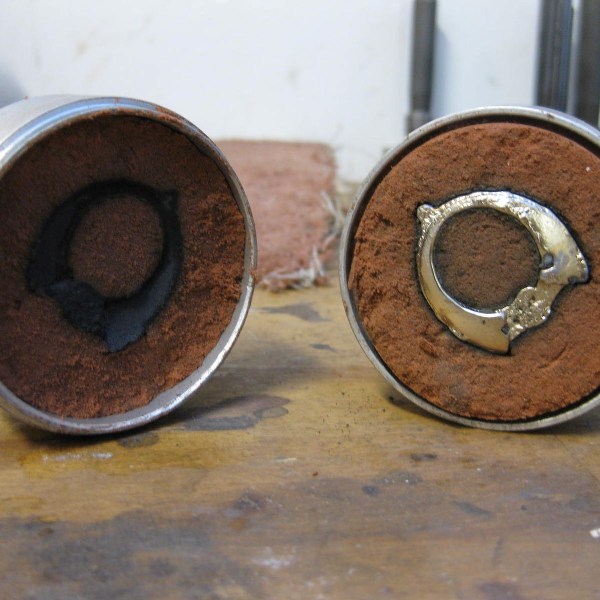
In my workshop, I also use another traditional casting method: sand casting. This is especially valuable when I remodel customers’ old jewellery. It is a technique for one-of-a-kind casting.
Sand casting requires more material than lost wax casting. To succeed, I need at least twice the amount of gold than the final piece will require. This is because the process relies on gravity. The molten metal must push itself into every crevice of the sand mould, and without the extra weight, the casting can fail. The result would be incomplete or misshapen.
Once the new piece is finished, I return any unused gold to my customer. This way, nothing is lost, and the sentimental value of their original material is preserved.
Sand casting has a different aesthetic from lost wax casting. It produces a rawer, more organic surface texture, which many clients find appealing. It also offers a sustainable way of giving old jewellery a new life.
Why Lost Wax Casting Still Matters Today
Lost wax casting continues to be an essential technique for jewellers worldwide. From mass production to bespoke artistry, it adapts to different needs. For some, it is about efficiency and reproducibility. For others, like me, it is about expression, carving, and storytelling.
What strikes me most is that this method has endured for thousands of years because it works so well. The fundamentals have not needed to change. Fire, wax, and metal come together in a process that still feels almost alchemical.
Conclusion: The Magic of Lost Wax Casting in Bespoke Jewellery

Although fabrication remains my primary method of working, lost wax casting has its place in my practice. For larger pieces, it provides strength and structure that would be laborious to achieve by hand. For remodelling projects, it allows me to give old gold new life. And for bespoke creations, it allows me to carve designs directly tailored to my clients’ gemstones and stories.
Every time I use the technique, I am reminded of its history. I imagine the goldsmiths of ancient civilisations carving wax in the flicker of lamplight. I imagine their awe as molten metal took shape. And I feel grateful that I can continue this lineage of craftsmanship in my own contemporary practice.
Lost wax casting is more than just a technique. It is a bridge between past and present. It connects me to ancient traditions while allowing me to create jewellery that is relevant today. Whether it is carving a bespoke wax for a client, remodelling old gold in sand, or exploring the versatility of different wax types, the technique offers endless possibilities.
Every piece of jewellery tells a story. And when that story begins in wax, the journey feels even more profound. If you are ready to begin your own journey and create your dream piece of bespoke jewellery, I warmly invite you to book an appointment with me and let’s bring your vision to life.