The State of Sustainability in the Jewellery Industry at The Goldsmiths’ Centre, 9 June 2025
Last Monday, I had the pleasure of attending the Fair Luxury Jewellery Conference at The Goldsmiths’ Centre in London. The event, titled “The State of Sustainability in the Jewellery Industry,” brought together makers, thinkers, and changemakers for an afternoon of thought-provoking talks and lively discussion panels. We tackled both the challenges and the progress within our industry when it comes to sustainability — a buzz word but not always clearly define.
Setting the Scene
The first session set the tone for the afternoon. Cristina Villegas, Founder and Director of Nature’s Wealth, posed a powerful question: “The future of gemstones… Are you with us?” Her talk looked at how responsible sourcing has evolved and how small changes can have a big impact on mining communities. Toby Pomeroy followed with an inspiring update on Mercury Free Mining, the organisation he founded to eliminate mercury from artisanal gold mining. I was moved by his determination and the progress they’ve made using safer technologies like the Goldrop system.
Then came Joanna Hardy, whose Personal Reflection on Visiting Gem Mines was deeply human and grounded. Her talk reminded us that gemstones are not just commodities, but the result of hard work and complex histories. Finally, Greg Valerio, jeweller and social activist spoke with conviction and clarity about PeaceGold, which uses gold as a tool for peacebuilding and social regeneration in post-conflict regions. His words challenged us all to look beyond gold’s market value — and towards its potential to transform lives.

Carbon Emissions and Jewellery

In the second session, I was honoured to be invited to sit on the panel discussing carbon emissions. Joining me were Charlie Cotton (ecollective), Chris Hocknell (Eight Versa), and Jos Skeates (EC One). The panel was moderated by fellow jeweller Susi Smither, founder of The Rock Hound and a fellow Fair Luxury team member.
We spoke honestly about the realities of reducing our carbon footprints in the jewellery world. From supply chain emissions to workshop energy use, the conversation was complex, but hopeful. It reminded me that small steps can lead to meaningful change, especially when we share knowledge across the industry.
What Has Been Achieved? What Still Needs Work?
Session three took us into the world of manufacturing. We heard from Alex Monroe, Aastha Sethi (Boodles), Kerry Sounders (Domino Jewellery/Weston Beamor), and Gary Wroe (NAJ). The panel, moderated by Charlotte Dew of The Goldsmiths’ Centre, explored the progress we’ve made in responsible production — and where we still fall short.
One insight that stood out came from Weston Beamor. They spoke about how they took action without waiting for customers to demand it. They installed solar panels, lined their ovens with thermal material to reduce energy use, and now recycle over 15,000 litres of water annually. It was a clear reminder that sustainability should begin with us — not with pressure from consumers.
Marketing, Greenwashing, and Greenwashing
The final session of the afternoon addressed responsible marketing and greenwashing — two topics I care deeply about. The panel featured Emma Beckett (EBPR), Jamie Moore (Positive Luxury), Katie Gillespie (NAJ), and Rebekah Ann (Rebekah Ann Jewellery). It was moderated by Rebecca Maddock, founder of Worn Studio and a fellow Fair Luxury member.
The biggest takeaway for me was around communication — and how we use language. The word “sustainability” is everywhere. It’s on websites, in captions, in conversations. But what does it really mean?
I’ve been thinking about this for some time, and the discussion reinforced my concerns. We say “sustainable”, but if we can’t back that up with clear definitions and transparent sourcing, the word loses meaning. I found myself asking: Should we be speaking instead about social responsibility, environmental action, or traceability?

© Photographer Julia Skupny, The Goldsmiths’ Centre, 2025
Redefining Sustainability in My Own Practice


On my website, I’ve spoken before about how mining is not sustainable. You can’t keep digging forever. So where does that leave artisanal miners? If we all turn to recycled gold, we leave those communities behind. Yes, recycling gold has its place, but it lacks transparencey, traceability and social sustainability. It doesn’t provide livelihoods for the people at the beginning of the supply chain.
That’s why I support slow mining — responsible, artisanal and small-scale mining (ASM) where the focus is on human dignity and environmental care. Artisanal mining is handlabour, using pickaxes and buckets, while small-scale operations use basic machinery. But both are vital, and both can be done with respect.
Cristina Villegas shared that responsible sourcing gemstones really began in 2015. A year later, the GIA introduced basic gemmological education for miners. Until then, many ASM miners sold gemstones by weight rather than value — often losing out on fair prices. Thanks to education and tools like the GIA’s free Gem Guide, miners are now empowered to assess and sell gemstones more accurately.
I also learnt more about Moyo Gems, which was founded in 2016. Their miners now earn around 95% of export value — compared to the industry average of just 35%. Documentation plays a key role here. When sales are properly recorded, it creates legal trade, creditworthiness, and traceability. It shows that transparency is possible.
Mercury, Conflict and Circular Economies
Toby Pomeroy shared a sobering statistic: 15 to 20 million small-scale gold miners release over 5,000 kg of mercury into the environment each year. Projects like Mercury Free Mining and Fairmined are fighting this. Fairmined miners in Peru use gravimetric tables (shaking tables) and panning to extract gold without mercury or cyanide. Mercury Free Mining uses the Goldrop, developed by John Richmond in 2018, which is making a real difference.
Greg Valerio’s talk stayed with me. Can gold help build peace? Through PeaceGold, mining cooperatives are trained in conflict resolution and supported to reintegrate ex-combatants. These province mines excavate around 5,000 to 6,000 kg of gold each year. But rather than watching wealth disappear to Dubai or China, PeaceGold builds a circular economy — where the value stays in the community. This, to me, is what fair luxury is really about.
My Own Reflections: Fair Luxury in Practice

The question I left with was: “How do I speak clearly and honestly about what I do?”
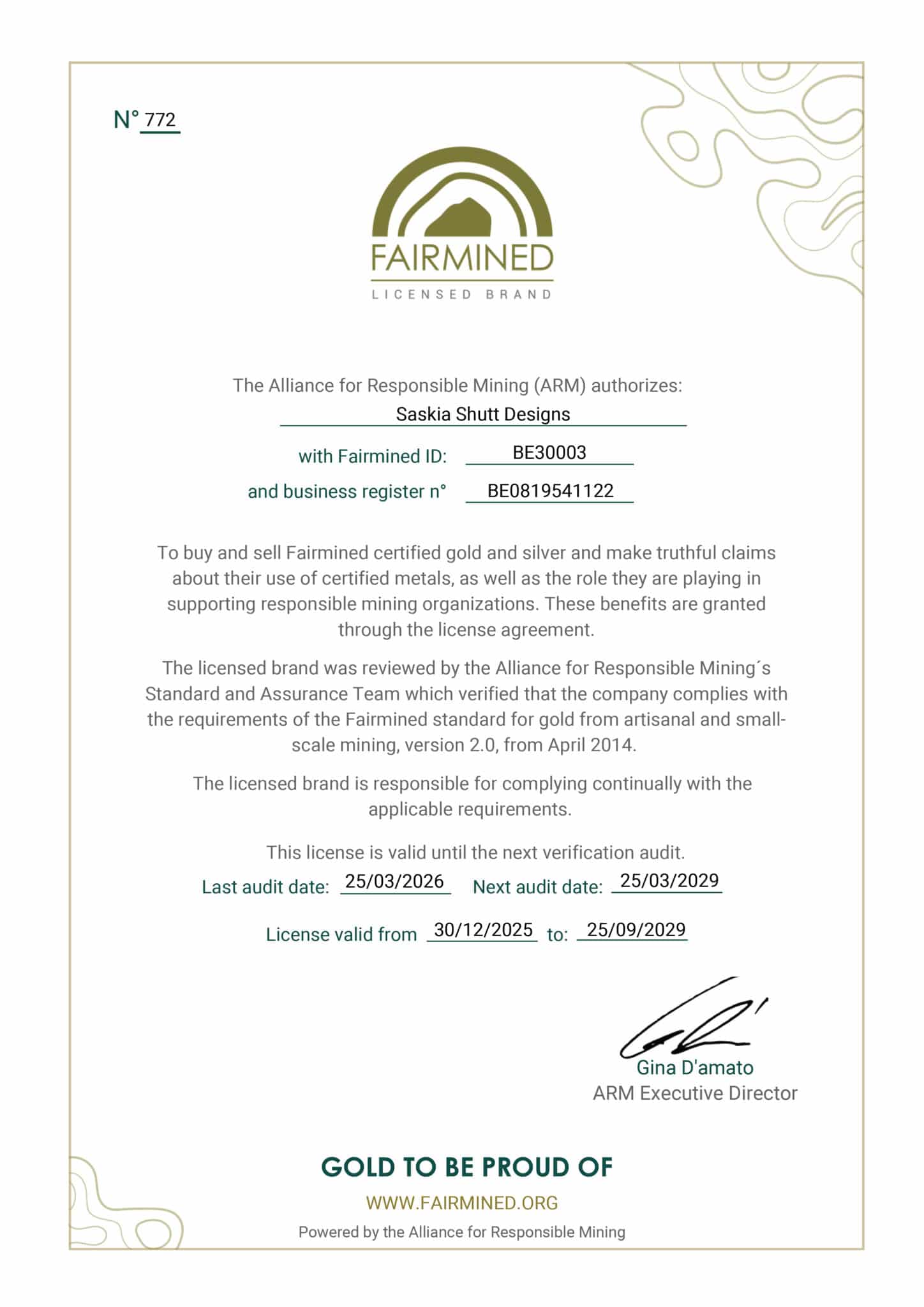
I’ve always felt uneasy using the word ethical. Everyone defines it differently. Instead, I focus on responsibility. I work with Fairmined-certified gold and source gemstones from transparent, ASM suppliers. This allows me to trace my materials and make conscious decisions in my work.
I don’t claim to be perfect — I’m still learning. But I’ve made real efforts to reduce my carbon footprint, which is part of why I was awarded the three-star Ecodynamic Label. More importantly, I want my clients to feel informed when they choose to work with me. They’re not just buying a piece of jewellery — they’re supporting a whole story of people, planet, and principle.
At the end of the day, I believe that miners should be able to thrive — not just survive. It’s because of them that I can do what I love. This belief underpins everything I do. You can read more in my article What Fairmined Means to Me.
A Mindset for the Future
The conference left me inspired. Meeting peers who care deeply about a fair luxury jewellery industry and sustainable practices reminded me that we’re not alone. From Moyo Gems to PeaceGold and Mercury Free Mining, I saw what’s possible when we work together.
We still have a long way to go, including around transparent well underpinned communication. But I feel hopeful. I’ve been part of this current for almost 10 years, and it’s heartening to see how far we’ve come. Fairness in the jewellery industry isn’t just a movement — it’s a mindset. And I’m proud to be part of it.